Boosting WebAssembly Performance with Speculative Optimizations and Deoptimization
Modern web applications demand fast execution, and WebAssembly (Wasm) has become a key technology for near-native performance in the browser. The V8 team recently introduced two powerful optimizations for WebAssembly in Chrome M137: speculative call_indirect inlining and deoptimization support. Together, they enable the compiler to generate more efficient machine code by making educated guesses based on runtime feedback. This yields significant speedups, especially for WebAssembly Garbage Collection (WasmGC) programs, and lays the groundwork for future improvements.
Background: From JavaScript to WebAssembly
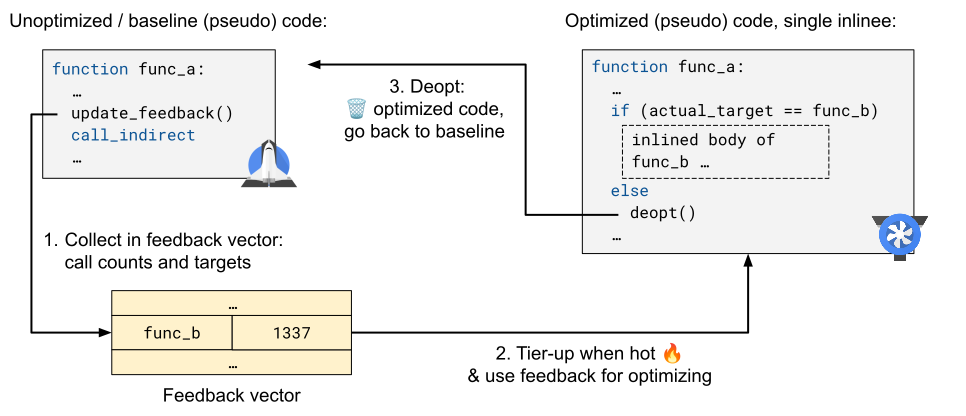
JavaScript engines like V8 have long relied on speculative optimizations to achieve high performance. When compiling JavaScript, just-in-time (JIT) compilers collect feedback during execution and make assumptions—for example, that a + b always involves integers. This allows the engine to emit specialized machine code for that case, avoiding the overhead of handling all possible types. If those assumptions later prove wrong, the engine performs a deoptimization (or deopt): it discards the optimized code and falls back to a more generic version, then continues collecting feedback for future re-optimization.
WebAssembly 1.0, however, didn't need such speculative tricks. Wasm modules are statically typed and often compiled from C, C++, or Rust—languages that are already well-suited to ahead-of-time optimization. Tools like Emscripten (based on LLVM) and Binaryen produce highly optimized binaries, making further speculative optimizations less critical. But the evolution of WebAssembly has changed that picture.
Speculative Optimizations and Deoptimization: A Closer Look
The two new features in V8 work hand in hand to boost Wasm performance. Speculative inlining allows the compiler to inline function calls when a specific callee (or a small set of callees) is frequently used at a particular call site. Deoptimization ensures correctness if the actual callee later differs from the speculated one.
How Speculative Inlining Works for WebAssembly
In WebAssembly, indirect function calls via call_indirect are common, especially in WasmGC programs that use virtual methods or interfaces. The compiler records which function is actually called at each indirect call site during profiling. If a single function is called 90% of the time, V8 speculatively inlines that function's code directly into the caller. This eliminates the overhead of the indirect call and enables further optimizations across the inlined code. If a different function is later invoked, the deoptimization mechanism kicks in.
The Role of Deoptimization
Deoptimization is the safety net that makes speculation feasible. When the runtime detects that the assumption made during compilation (e.g., which function to inline) no longer holds, it triggers a deopt. The engine reverts to a less optimized but correct version of the code, often after collecting more feedback. This is similar to how JavaScript engines handle type changes. For WebAssembly, deoptimization had to be carefully implemented because Wasm’s low-level nature and structured control flow differ from JavaScript’s.
Why WasmGC Changes the Game
The introduction of WasmGC (the Garbage Collection proposal) brings WebAssembly to a new level of expressiveness. WasmGC supports high-level features like structs, arrays, subtyping, and operations on these types—making it suitable for compiling managed languages such as Java, Kotlin, Dart, and Go. The bytecode is more abstract than Wasm 1.0, leaving more room for runtime speculation. For instance, virtual method calls are common in object-oriented languages, and they map directly to indirect calls that benefit from speculative inlining.
Without speculation, the compiler would need to emit generic code that handles many possible types and call targets. With speculative optimizations, the engine can generate tight, specialized code for the most common cases and fall back gracefully when needed.
Real-World Performance Gains
The combination of speculative inlining and deoptimization has already shown impressive results. On a set of Dart microbenchmarks, V8 achieved an average speedup of more than 50%. For larger, realistic applications and benchmarks, the improvements range from 1% to 8%. These gains come from reducing indirect call overhead and enabling better register allocation and code layout. As WasmGC adoption grows, these numbers are expected to improve.
Looking Ahead: Future Optimizations
Deoptimization is not just a one-off feature; it is a foundational building block for many other optimizations. Future work may include speculative type specialization (e.g., assuming a field is always an integer), loop unrolling, and more aggressive inlining. The ability to revert safely means V8 can take bolder decisions, ultimately bringing WebAssembly execution closer to native speeds, even for high-level languages.
These developments demonstrate that WebAssembly continues to evolve, and the boundary between compiled and interpreted code grows thinner. By borrowing successful techniques from JavaScript JIT compilers, V8 is making Wasm faster and more versatile for the next generation of web applications.
Related Articles
- Flutter’s Big Moment at Google Cloud Next 2026: Key Announcements and Experiences
- Tank Pad Ultra: Rugged Android Tablet with Integrated 1080p Projector and Massive Battery
- Flutter Core Team Takes Global Tour in 2026 – Here’s Where to Meet Them
- Leaving the Sea of Nodes: V8's Shift to Turboshaft
- How V8 Achieved a 2.5x Speedup by Rethinking Heap Number Storage
- The Great Divide: One Nation Represents Australia’s Top Renewable Regions While Campaigning Against Them
- Building Your Fleet's Charging Backbone: A Guide to Tesla’s Semi Charging Program
- eVTOL vs EV Motors: Key Engineering Differences Explained